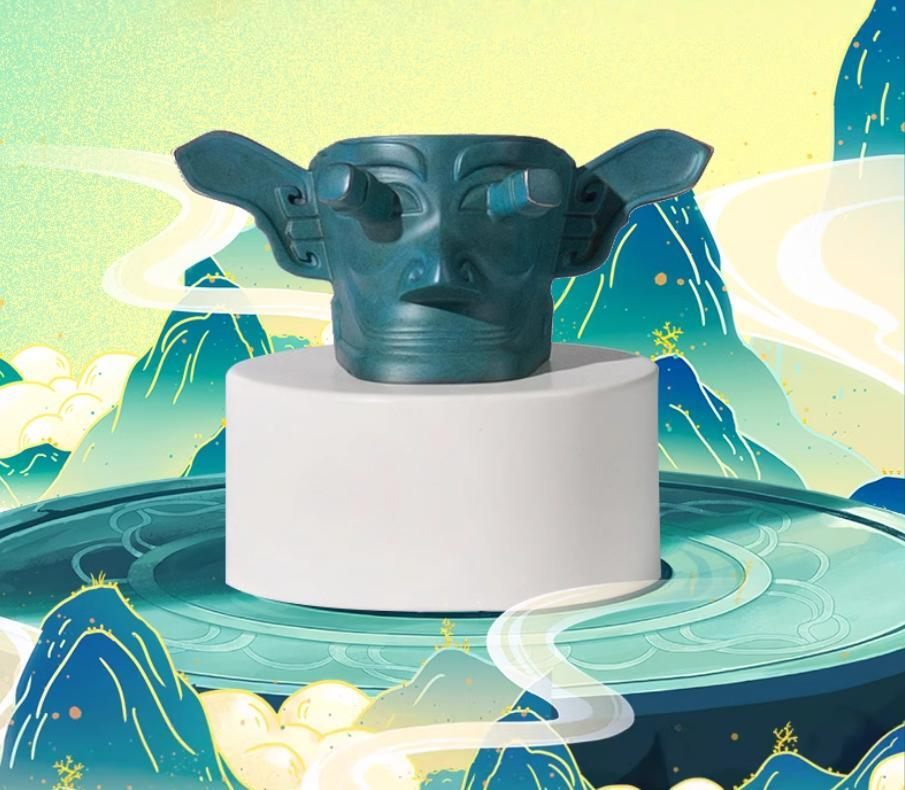

In the autumn of 1963, during one of the darkest chapters of modern Chinese history, a desperate farmer in Shaanxi Province dug up something extraordinary from his backyard. The Three-Year Famine had ravaged the countryside. Food was scarce. Survival was the only priority. What he unearthed—a massive bronze vessel covered in mysterious beast faces and ancient symbols—meant nothing to him except potential cash.
He sold it to a local recycling station for scrap metal.
Nearly melted away. Forever lost.
But fate had other plans for this 3,000-year-old artifact. Two years later, in 1965, a museum curator conducting a routine inspection at the recycling station spotted it among piles of destined-for-destruction bronzes. Thirty yuan changed hands. The vessel was saved.
What the curator held in his hands would soon shock the archaeological world: He Zun, the bronze age china western zhou dynasty ritual wine vessel that contains the earliest written record of chinese civilization's most powerful phrase—the first appearance of the characters that would become the name of an entire nation.
"Zhai Zi Zhong Guo." Dwelling in the Central State.
The earliest reference to China word ever discovered.
The Dramatic He Zun Discovery Story 1963—From Scrap Heap to National Treasure
To understand the magnitude of this discovery, you need to understand the context. The year was 1963. China was emerging from the catastrophic Great Famine. In Jiacun Village, Baoji City, Shaanxi Province, a farmer whose name history forgot was digging in his courtyard, perhaps looking for usable materials, perhaps just trying to survive.
His shovel hit something hard.
What emerged from the earth was a bronze vessel of staggering proportions: 38.8 centimeters tall, weighing 14.6 kilograms, its surface covered in intricate taotie pattern designs—mythical beast faces with bulging eyes and gaping mouths that seemed to stare across three millennia. Swirling cloud thunder pattern spirals filled every gap. Single-legged kui dragon pattern motifs coiled around the vessel's body like ancient guardians.
This was no ordinary artifact. This was a ritual wine vessel from the Western Zhou Dynasty, crafted around 1046-1043 BCE during the reign of Zhou Chengwang, the young king who inherited a fractured empire from his father, King Wu.
But the farmer didn't know this. He saw scrap metal. The recycling station saw raw material. The vessel's fate seemed sealed.
Until the museum curator arrived.
The 1965 rescue of He Zun reads like a thriller. Baoji Museum staff were conducting what should have been a mundane inventory check at a metal recycling facility. Among tons of bronze destined for the furnace, one piece caught the curator's eye. The craftsmanship was too refined. The patterns too sophisticated. The weight too substantial.
He negotiated. Thirty yuan—roughly $10 USD at the time—purchased what would become one of China's most important archaeological discoveries.
Today, He Zun resides in the Baoji Bronzeware Museum, where millions have seen it. But that 1963 discovery event nearly ended in catastrophe. The near melted away chinese bronze treasure story has become legend among Chinese archaeologists—a reminder of how fragile cultural heritage truly is.
Where Does China Get Its Name From? The 122-Character Inscription That Changed Everything
Here's where the story transcends archaeology and enters the realm of national identity.
When curators cleaned He Zun and examined its interior, they found something extraordinary: 122 characters of铭文 (bronze inscription) cast into the vessel's base. These weren't decorative. They were a royal decree. A historical record. A king's words frozen in metal for eternity.
The inscription recounts a pivotal moment in Zhou Chengwang building Luoyi ancient capital. After his father King Wu overthrew the corrupt Shang Dynasty, Zhou Chengwang faced an enormous challenge: how to govern a vast, fractured territory stretching hundreds of miles from his western power base.
His solution? Build a new eastern capital at Luoyi (modern-day Luoyang)—a strategic location at the geographic center of his realm.
The inscription describes the ceremony where Zhou Chengwang addressed his nobles, including a man named He—the vessel's owner, a royal clansman who received this bronze as a reward for his loyalty. The king performed rituals, made offerings to heaven and his ancestors, and declared his intention to establish the eastern capital.
Then came the phrase that would echo through history:
"宅兹中国" (Zhai Zi Zhong Guo)
Literally translated: "Dwelling in the Central State."
This is the earliest evidence of chinese national identity ever found. The zhong guo character origin story begins here, in this bronze vessel, in this inscription, from this moment around 1040 BCE.
But what did "Zhong Guo" mean then?
Not what you think.
Western scholars have debated this extensively. Some argue it referred only to the geographic center—the Luoyi region itself. Others contend it reflected an early form of china concept evolution pre qin period—a proto-national consciousness that distinguished the Zhou realm from surrounding "barbarian" territories.
The china name first appearance written record doesn't match the modern People's Republic of China. Instead, it represents something more profound: the earliest reference to china word as a civilizational concept, a cultural center, a mandate from heaven.
When you ask "where does china get its name from," the answer leads directly to He Zun.
Zhou Dynasty Founding King Chengwang and the Political Masterpiece Behind the Bronze
To appreciate He Zun's significance, you must understand the man who commissioned it: Zhou Chengwang.
He was young when he inherited the throne—perhaps only 13 years old. His father, King Wu, had accomplished the impossible: overthrowing the Shang Dynasty after centuries of their rule. But victory on the battlefield is one thing. Governing an empire is another.
The Shang had ruled from their eastern strongholds. The Zhou were westerners, from the Wei River valley in what is now Shaanxi Province. How do you control territory you've never governed, populated by people who may resent your rule?
Zhou Chengwang eastern expansion strategy was brilliant in its simplicity: build a new capital at the center.
Luoyi ancient capital zhou dynasty location was no accident. It sat at the geographic heart of the Zhou realm, equidistant from western power bases and eastern territories. From Luoyi, the king could project power in all directions. He could administer justice. He could collect tribute. He could demonstrate the mandate of heaven that justified Zhou rule.
He Zun was part of this political theater. The vessel wasn't just a wine container. It was a prop in a carefully choreographed ceremony where Zhou Chengwang legitimized his rule, rewarded loyal nobles like He, and announced his grand vision to the world.
The western zhou dynasty royal decrees bronze inscriptions served multiple purposes:
1. Historical record: Documenting important events for posterity
2. Political propaganda: Demonstrating the king's power and legitimacy
3. Religious ritual: Communicating with ancestors and heaven
4. Social hierarchy: Reinforcing the feudal system through gift-giving
When He received this vessel, he wasn't just getting a fancy cup. He was receiving tangible proof of his relationship with the king, his place in the feudal order, his family's honor for generations to come.
This is how ancient chinese kings used bronze vessels—as instruments of statecraft, as symbols of power, as eternal records carved in metal.
What Is He Zun Artifact Significance? Decoding the Mystery of Its Owner "He"
Here's a puzzle that continues to fascinate historians: who was He?
The inscription mentions him by name. He was clearly important enough to receive a royal decree cast in bronze—a tremendous honor. He was present at the ceremony where Zhou Chengwang announced the eastern capital project. He was close enough to the king to be mentioned in this eternal record.
But what happened to He Zun owner He? History, frustratingly, is silent.
Some scholars speculate he was a member of the royal clan, perhaps a brother or cousin of Zhou Chengwang. Others suggest he was a military commander who had served with distinction during the Zhou conquest of Shang. A few propose he was an administrator tasked with overseeing the Luoyi construction project.
The He Zun mystery recipient identity puzzle may never be fully solved. But that uncertainty adds to the vessel's allure. Every time you look at He Zun, you're looking at an artifact connected to a real person who lived 3,000 years ago, whose name we know but whose story remains incomplete.
This is the power of ancient chinese bronze inscription meaning—it connects us directly to individuals across the chasm of time. Not kings or generals whose names fill history books, but a man named He, honored by his king, commemorated in bronze, remembered across three millennia.
The 122 character inscription He Zun translation has been studied by generations of scholars. Leading experts like Li Xueqin He Zun inscription interpretation and renowned archaeologist Zhang Guangzhi Chinese archaeology He Zun have dedicated careers to understanding every character, every phrase, every implication.
Their work has revealed not just historical facts, but insights into western zhou dynasty political system—how power was structured, how loyalty was rewarded, how legitimacy was maintained.
How Did China Ancient Name Evolve? From "Central State" to Modern Nation
The journey from "Zhai Zi Zhong Guo" to "China" is a story spanning 3,000 years.
In Zhou Chengwang's time, "Zhong Guo" referred to the central states—the Zhou realm itself, distinguished from surrounding territories inhabited by non-Zhou peoples. It was a geographic and cultural concept, not a national one in the modern sense.
Over centuries, the meaning expanded and contracted with China's political fortunes:
- Han Dynasty (206 BCE - 220 CE): "Zhong Guo" began to carry stronger ethnic and cultural connotations, distinguishing Han Chinese from neighboring peoples.
- Tang Dynasty (618-907 CE): The term gained international recognition as Chinese civilization reached its cosmopolitan peak.
- Song Dynasty (960-1279 CE): Facing military threats from northern nomads, "Zhong Guo" became a marker of cultural superiority and legitimacy.
- Ming Dynasty (1368-1644 CE): The concept solidified as a self-conscious national identity.
- Qing Dynasty (1644-1912 CE): Manchu rulers adopted "Zhong Guo" to legitimize their rule over Han territories.
- Republic of China (1912-1949): "Zhong Guo" became the official name of the modern nation-state.
- People's Republic of China (1949-present): The term continues as the country's formal name.
The how did china ancient name evolve question reveals something profound: nations are not eternal. They are constructed, imagined, negotiated across generations. He Zun captures one of the earliest moments in that construction—the moment when a king declared his realm the "Central State" and cast that declaration in bronze for eternity.
For Western audiences, this parallels their own national naming stories. The United States didn't become "America" overnight. Rome wasn't built in a day. Names carry weight, history, identity. He Zun is China's birth certificate—the earliest written record of a civilization naming itself.
Why Was He Zun Buried in Field? The Enduring Mystery of Its Final Resting Place
One question haunts every visitor who sees He Zun: why was it buried?
The vessel wasn't excavated from a royal tomb. It wasn't recovered from a palace ruin. It was found in a farmer's backyard in Jiacun Village, buried in earth for 3,000 years.
Several theories exist:
Theory 1: Ritual Burial. Some scholars suggest He Zun was intentionally buried as part of a religious ceremony. Perhaps when the Zhou Dynasty fell or when the owner's family line ended, the vessel was interred to accompany ancestors into the afterlife.
Theory 2: Hiding from Invasion. Others propose it was buried during a time of war—hidden to protect it from invading forces who would melt down bronze for weapons. The Zhou Dynasty eventually collapsed into the Warring States period, a time of chaos and conflict.
Theory 3: Forgotten Legacy. The simplest explanation: the vessel was buried by descendants who could no longer maintain it, and over generations, its location was forgotten. The family died out. The land changed hands. The bronze slept underground.
The why was He Zun buried in field question may never be definitively answered. But that uncertainty is part of its mystique. Every artifact has a biography—a life story from creation to discovery. He Zun's biography includes 3,000 years of silence, interrupted only by a farmer's shovel and a curator's keen eye.
Near Melted Away Chinese Bronze Treasure—The Survival Story That Almost Wasn't
Let's return to that moment in 1963 when He Zun's existence hung in the balance.
Imagine the scene: a recycling station during the Great Famine. Metal is valuable. Bronze can be melted and repurposed. The farmer needs money. The recycling station needs raw materials. The vessel has no context, no documentation, no one to speak for it.
It should have been destroyed.
Thousands of artifacts were lost this way during China's turbulent 20th century. The Cultural Revolution would later see countless treasures smashed, burned, melted. The fact that He Zun survived is nothing short of miraculous.
The near melted away chinese bronze treasure narrative resonates with universal themes:
- Fragility of heritage: How easily history can be erased
- Role of individuals: One curator's expertise saved a national treasure
- Luck and timing: Being in the right place at the right moment
- Value beyond price: What makes something irreplaceable?
Today, He Zun is insured for millions. It's featured in textbooks, documentaries, exhibitions. It's one of China's 64 cultural relics forbidden from being exhibited abroad—too precious to risk outside the country.
But in 1965, it was worth 30 yuan.
That disparity tells you everything about how we assign value to the past. He Zun was always priceless. We just didn't know it yet.
Baoji Shaanxi Bronze Artifacts History—Why This Region Matters
The discovery of He Zun in Baoji, Shaanxi Province was no accident. This region is archaeology's equivalent of a gold mine.
Baoji sits in the Wei River valley, the heartland of Zhou civilization. When the Zhou overthrew the Shang around 1046 BCE, they ruled from this area. Their capitals, their royal tombs, their ritual centers—all concentrated here.
Since the 1960s, Baoji Shaanxi bronze artifacts history has unfolded like a treasure hunt:
- 1963: He Zun discovered
- 1970s: Multiple Western Zhou bronze caches unearthed
- 2000s: Additional royal tombs and ritual sites identified
The Baoji Bronzeware Museum now houses one of the world's finest collections of Zhou Dynasty bronzes. Scholars pilgrimage here to study inscriptions, analyze casting techniques, reconstruct ancient history.
For visitors, the museum offers something rare: a concentrated view of a civilization at its peak. He Zun is the star, but it's surrounded by contemporaries—other vessels, other inscriptions, other stories from the same era.
The bronze ware museum Baoji China visit guide recommendation is simple: if you're interested in ancient Chinese history, this museum is essential. He Zun alone justifies the trip. The rest of the collection makes it unforgettable.
China Name First Appearance Written Record—Why This Matters to the World
You might wonder: why should anyone outside China care about He Zun?
The answer lies in what this vessel represents: the birth of civilizational identity.
Every major civilization has its founding moments—its declarations of selfhood. For the United States, it's the Declaration of Independence. For Rome, it's the founding myths of Romulus and Remus. For Greece, it's the Homeric epics.
For China, it's He Zun.
The earliest reference to china word isn't just a linguistic curiosity. It's evidence of a people defining themselves, distinguishing their realm from others, articulating a vision of centrality and legitimacy.
This matters because:
1. It challenges Western narratives. For centuries, Western scholars assumed Chinese national identity was a modern invention, influenced by European concepts. He Zun proves otherwise—the concept of "Zhong Guo" predates Christ by 1,000 years.
2. It reveals universal patterns. Every civilization creates origin stories. Every nation names itself. He Zun shows China doing what all civilizations do: asserting its place in the world.
3. It bridges past and present. When modern Chinese people say "Zhong Guo," they're using a term that connects them to Zhou Chengwang, to He, to 3,000 years of continuous civilization. That continuity is rare in human history.
4. It demonstrates the power of material culture. Words fade. Manuscripts decay. But bronze endures. He Zun survived because it was made to last—crafted with techniques so sophisticated that modern engineers still study them.
The earliest evidence of chinese national identity isn't abstract. It's tangible. You can see it. Photograph it. Stand before it in a museum and feel the weight of three millennia.
That's the power of He Zun.
He Zun Mystery Recipient Identity Puzzle—What We Still Don't Know
Despite decades of research, mysteries remain:
Who exactly was He? We know his name. We know he was important. But his full identity, his family lineage, his ultimate fate—lost to time.
Why was this vessel buried? Ritual? War? Neglect? Each theory has merit. None can be proven.
What happened to the other bronzes from this ceremony? He Zun wasn't created in isolation. Other vessels were likely cast for other nobles present at Zhou Chengwang's declaration. Where are they now?
Are there more inscriptions waiting to be discovered? The Baoji Shaanxi bronze artifacts history suggests yes. Archaeologists continue to find new sites, new tombs, new treasures.
The He Zun mystery recipient identity puzzle reminds us that history is never complete. Every answer generates new questions. Every discovery opens new frontiers.
This is why He Zun continues to fascinate. It's not a closed book. It's an ongoing conversation between past and present, between archaeologists and artifacts, between China and the world.
Conclusion: The Bronze That Named a Nation
He Zun is more than a bronze vessel. It's a time capsule. A declaration. A miracle of survival.
From its creation around 1040 BCE to its discovery in 1963 to its current status as a national treasure, He Zun has witnessed three millennia of Chinese history. It survived the fall of dynasties, the rise of empires, the chaos of war, the indifference of a starving farmer, and the furnaces of a recycling station.
And it carries within it the earliest reference to china word—the moment when a civilization named itself.
When you stand before He Zun in the Baoji Bronzeware Museum, you're not just looking at an artifact. You're looking at the birth certificate of China. You're seeing the earliest written record of chinese civilization's self-definition. You're witnessing the china name first appearance written record that continues to resonate today.
The farmer who found it couldn't have known. The curator who saved it might have suspected. But now we know: He Zun is irreplaceable.
It's the bronze that named a nation.
And it almost became scrap metal.