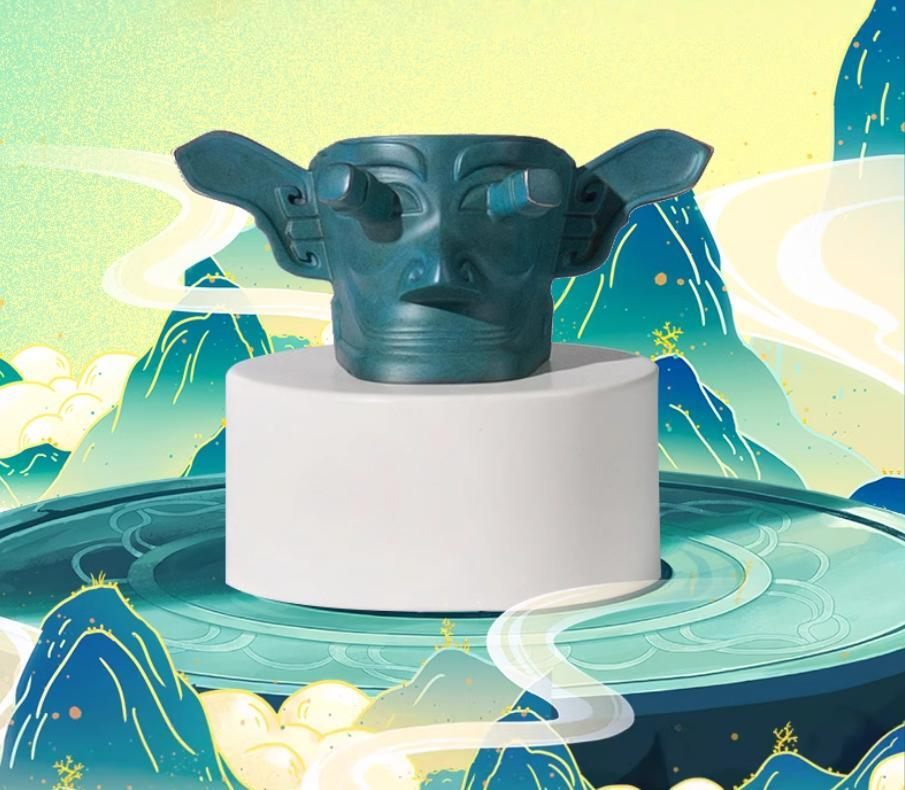

In the dim light of a museum gallery in Beijing, a bronze vessel stands alone, its surface alive with movement. A dragon coils through clouds, sinuous and celestial. A tiger crouches below, muscular and terrestrial. They do not fight—they dance. This is the Dragon Tiger Zun, a Shang Dynasty bronze ritual vessel that has puzzled archaeologists, mesmerized art historians, and whispered secrets of an ancient civilization's cosmic vision for over three millennia.
Discovered by a farmer in 1957 along the Yueyue River in Funan County, Anhui Province, this Chinese bronze dragon tiger sculpture represents one of the most extraordinary achievements of ancient Chinese bronze animal art. Standing approximately 50 centimeters tall with a flared mouth of 45 centimeters, the vessel's imposing presence belies the delicate complexity of its decoration. But what makes this Shang Dynasty bronze dragon design truly exceptional is not merely its craftsmanship—it is the profound philosophical statement carved in metal: the eternal balance between heaven and earth, yang and yin, the celestial dragon and the terrestrial tiger.
The Discovery That Changed Chinese Archaeology: A Farmer's Accident in 1957
The story begins not in a royal tomb or a grand archaeological expedition, but in the humble hands of an anonymous farmer. In 1957, while digging soil near the Yueyue River in Funan County, Anhui Province, this farmer's shovel struck something hard. What emerged from the earth would become one of the most significant Chinese bronze vessel tiger pattern discoveries of the 20th century.
The location itself carries mystery. Funan County lies on the periphery of what archaeologists consider the core Shang Dynasty territory. Why would such a sophisticated Chinese bronze zoomorphic vessel art piece appear in this borderland region? Some scholars suggest it indicates the far reach of Shang cultural influence, while others propose it represents a local elite's adoption of central plain artistic traditions. This geographical ambiguity only deepens the intrigue surrounding the ancient bronze dragon statue China has come to treasure.
Archaeological teams subsequently excavated the site, confirming it as a significant Shang Dynasty settlement. The Dragon Tiger Zun was carefully transported to Beijing, where it now resides in the National Museum of China, protected as a first-class national treasure. The 1957 discovery transformed our understanding of Chinese bronze decorative animal pattern distribution and challenged previous assumptions about the geographical boundaries of Shang artistic production.
A Visual Symphony: Decoding the Dragon Tiger Bronze Art Meaning
To stand before the Dragon Tiger Zun is to witness a moment frozen in bronze—a moment where two of China's most powerful mythological creatures engage in an eternal choreography. The Chinese bronze artistic animal design displays the dragon in the upper register, its body undulating through stylized clouds, claws extended, horns sweeping backward. Below, the tiger emerges from mountainous forms, its mouth open in a silent roar, muscles taut with restrained power.
This Shang bronze creature artistry design is not merely decorative. It embodies a sophisticated cosmological vision. In ancient Chinese bronze symbolism, the dragon represents the heavens, water, rain, and imperial authority—the yang principle. The tiger symbolizes the earth, mountains, wind, and military power—the yin principle. Their coexistence on a single Chinese ritual bronze mythological art vessel suggests a worldview where opposites do not conflict but complement, where cosmic balance is achieved through dynamic tension rather than static harmony.
Western art historians encountering this Chinese bronze mythical creature art often struggle to categorize it. Is it sculpture? Is it functional art? The answer, as with much of ancient bronze vessel artistic balance design, is both. The vessel served a ritual purpose—likely holding wine for ancestral offerings—while simultaneously functioning as a three-dimensional philosophical treatise on the nature of existence.
The Artistic Revolution: How Shang Dynasty Art Bronze Dragon Master Craftsmen Achieved the Impossible
The technical achievement of the Dragon Tiger Zun cannot be overstated. Creating this Chinese bronze monumental dragon art required mastery of multiple casting techniques, precise control of metal alloys, and an artistic vision that transcended mere representation. The vessel was produced using a combination of piece-mold casting and lost-wax techniques, methods that would not be fully understood by Western archaeologists until the 20th century.
The ancient Chinese metal dragon sculpture displays a level of detail that seems almost impossible given the technological constraints of 1200 BCE. Each scale of the dragon, each stripe of the tiger, each cloud swirl was individually modeled in clay before being cast in bronze. The Chinese bronze dynamic pattern design required the craftsmen to create separate molds for different sections, then assemble them with such precision that the seams remain nearly invisible after three millennia.
Metallurgical analysis reveals that the Shang art bronze sacred animal contains a sophisticated alloy of copper, tin, and lead in proportions that optimize both fluidity during casting and durability after cooling. This Chinese bronze aesthetic harmony of material science and artistic vision represents a pinnacle of ancient bronze sacred animal China craftsmanship that would not be surpassed for centuries.
The bronze vessel dragon artistic heritage extends beyond technical skill to encompass a profound understanding of visual narrative. The craftsmen did not simply depict animals—they captured movement, tension, and philosophical meaning in static metal. This Shang Dynasty bronze visual conflict between the dragon's upward surge and the tiger's grounded power creates a visual rhythm that draws the viewer's eye in continuous circulation around the vessel.
From Ritual Object to Museum Masterpiece: The Journey of the Chinese Bronze Art Dragon Exhibition
For over 3,000 years, the Dragon Tiger Zun served a sacred function. In the dimly lit ancestral halls of Shang nobility, it would have been filled with millet wine, its contents offered to deceased ancestors whose spirits were believed to influence the living world. The Chinese bronze vessel dragon legacy carried not just liquid, but prayers, petitions, and the weight of dynastic continuity.
The vessel's transition from ritual object to museum artifact reflects broader changes in how Chinese civilization understands its own heritage. During the Shang Dynasty, the Shang bronze dragon artistic achievement was valued for its spiritual efficacy. Today, the Chinese bronze sculptural animal form is treasured for its artistic and historical significance. Yet both perspectives acknowledge the object's power to connect the mortal realm with something greater.
In its current home at the National Museum of China, the ancient Chinese bronze dragon tradition draws thousands of visitors annually. Many come seeking connection with their ancestral past. Others, particularly Western visitors, approach the bronze dragon fine art China with fascination for its alien beauty and sophisticated artistry. The Chinese bronze dragon art significance transcends cultural boundaries, speaking to universal human concerns about power, balance, and our place in the cosmos.
The Cosmic Dance: Understanding Chinese Bronze Aesthetic Harmony Through Eastern Philosophy
To fully appreciate the Dragon Tiger Zun, one must understand the philosophical framework that produced it. The Chinese bronze dynamic pattern design is not arbitrary decoration but a visual manifestation of concepts that would later be formalized in Daoist and Confucian thought. The dragon-tiger pairing represents what Chinese philosophers call "oppositional complementarity"—the idea that apparent contradictions actually constitute a unified whole.
The Shang Dynasty bronze visual conflict between dragon and tiger mirrors the later concept of yin-yang, though it predates formal yin-yang theory by centuries. The dragon, associated with heaven, water, and transformative power, embodies yang energy—active, ascending, creative. The tiger, linked to earth, mountains, and protective force, embodies yin energy—receptive, descending, preservative. Together on the Chinese bronze vessel artistic balance, they create a complete cosmological system.
This ancient bronze vessel artistic balance reflects a worldview fundamentally different from Western dualistic traditions. Where Greek philosophy often positioned opposites in conflict (good versus evil, mind versus body), Shang cosmology envisioned them as interdependent. The Chinese bronze mythical creature art does not show the dragon defeating the tiger or vice versa—it shows them coexisting in dynamic equilibrium.
The Chinese bronze artistic animal design also encodes seasonal and directional symbolism. The dragon corresponds to spring and the east, the tiger to autumn and the west. Their presence on a single Shang bronze creature artistry design suggests a vessel that encompasses the full cycle of time and space—a microcosm of the universe rendered in bronze.
Technical Marvel: The Ancient Chinese Metal Dragon Sculpture Casting Process Revealed
Modern archaeological science has begun to unlock the secrets of how the Dragon Tiger Zun was created. Using X-ray fluorescence and computed tomography, researchers have mapped the vessel's internal structure without damaging the artifact. What they discovered confirms the extraordinary sophistication of Shang Dynasty bronze dragon design production.
The Chinese bronze decorative animal pattern was created using a multi-piece mold system. Craftsmen first sculpted the desired design in clay, then created negative molds from this model. These molds were fired to create durable ceramic shells, which were then assembled with incredible precision. Molten bronze—heated to approximately 1,000 degrees Celsius—was poured into the assembled mold cavity.
The Chinese bronze zoomorphic vessel art required separate molds for the dragon, tiger, and background elements, each needing perfect alignment during casting. Any misalignment would have resulted in visible seams or structural weaknesses. The fact that the ancient bronze dragon statue China displays virtually no casting defects testifies to the masterful skill of its creators.
Metallurgical analysis reveals the Chinese bronze vessel tiger pattern contains approximately 80% copper, 15% tin, and 5% lead—a ratio that optimizes both the fluidity needed for detailed casting and the hardness required for a durable ritual vessel. This Shang bronze creature artistry design alloy formula represents centuries of accumulated metallurgical knowledge, refined through generations of bronze workers.
The Borderland Mystery: Why Did This Chinese Ritual Bronze Anhui History Appear in Funan County?
One of the most enduring puzzles surrounding the Dragon Tiger Zun is its provenance. Funan County, Anhui Province, lies well outside the traditional heartland of Shang civilization, centered in the Yellow River valley of Henan Province. The presence of such a sophisticated Chinese bronze dragon tiger sculpture in this peripheral region has sparked intense scholarly debate.
Several theories attempt to explain this Chinese bronze vessel Anhui excavation anomaly. One suggests that the vessel was created in the Shang capital and later transported to Funan through trade, tribute, or conquest. Another proposes that local elites in Anhui adopted Shang artistic styles and commissioned works from itinerant craftsmen. A third theory posits the existence of a previously unknown regional bronze-casting tradition influenced by, but distinct from, central plain styles.
The Funan County bronze archaeological site where the vessel was discovered has yielded additional artifacts, though none matching the Dragon Tiger Zun's sophistication. This isolation suggests the vessel may have been a special commission, perhaps created for a local ruler with close ties to the Shang court. The Chinese bronze sacred vessel ritual function would have been equally important in the periphery as in the capital, serving to legitimize local authority through connection to central religious practices.
Recent archaeological surveys in Anhui have uncovered additional Shang Dynasty edge region bronze artifacts, suggesting the Shang cultural sphere extended farther than previously believed. The Dragon Tiger Zun may represent not an anomaly but a glimpse into a more complex pattern of cultural exchange and political relationship between the Shang center and its peripheries.
Comparative Mythology: Chinese Dragon Tiger vs Western Lion and the Universal Language of Sacred Animals
The Dragon Tiger Zun offers a fascinating opportunity for cross-cultural comparison. Western artistic traditions feature their own powerful animal symbolism—the lion representing royalty and courage, the eagle symbolizing divine authority, the serpent embodying both wisdom and danger. How does the Chinese bronze dragon tiger sculpture compare to these familiar Western motifs?
The dragon-tiger pairing has no direct equivalent in Western mythologists traditions. Greek mythology features chimeras and hybrid creatures, but rarely pairs two distinct powerful animals in balanced opposition. The closest parallel might be the heraldic tradition of supporting animals flanking a coat of arms, but even this lacks the philosophical depth of the Chinese bronze dragon tiger sculpture composition.
What makes the ancient Chinese bronze dragon sculpture particularly intriguing to Western audiences is its synthesis of naturalism and symbolism. The dragon and tiger are rendered with careful attention to anatomical detail—muscles, claws, scales all observe real animal forms. Yet these realistic elements serve a symbolic purpose entirely absent from most Western lion representations, which typically emphasize power without philosophical subtext.
The Chinese bronze mythical creature art also differs in its treatment of movement. Western animal sculpture often captures a single moment—a lion mid-roar, an eagle in flight. The Dragon Tiger Zun suggests continuous, cyclical motion. The dragon and tiger are not frozen in action but engaged in an eternal dance, a Chinese bronze dynamic pattern design that implies perpetual transformation rather than static power.
The Spiritual Dimension: Ancient Chinese Bronze Religious Meaning and Ancestral Communication
To understand the Dragon Tiger Zun fully, we must appreciate its original spiritual context. This was not created as art for art's sake but as a vessel for communicating with the divine. In Shang religious practice, bronze vessels like the Chinese ritual bronze mythological art served as intermediaries between the human and spiritual realms.
During ritual ceremonies, the Chinese bronze zun ritual wine vessel would be filled with millet wine, which was then offered to ancestral spirits. The smoke and aroma rising from the vessel were believed to carry prayers and petitions heavenward. The dragon tiger bronze art meaning took on additional significance in this context—the dragon facilitating ascent to heaven, the tiger grounding the ceremony in earthly reality.
The ancient Chinese bronze casting myth surrounding such vessels suggests they were believed to possess inherent spiritual power. The Chinese bronze sacred vessel ritual function extended beyond mere container—the vessel itself was a sacred object, its decoration imbued with cosmological significance. The Shang Dynasty bronze celestial design was not ornamental but operational, designed to facilitate communication between realms.
Archaeological evidence suggests that bronze vessels were sometimes buried with their owners, continuing their ritual function in the afterlife. The Chinese bronze vessel spiritual offering role thus extended beyond a single ceremony to encompass the eternal relationship between the living and the dead. This ancient Chinese bronze religious meaning adds layers of significance to every decorative element, transforming the Dragon Tiger Zun from art object to spiritual technology.
Preservation and Legacy: The Dragon Tiger Zun National Museum Home
Today, the Dragon Tiger Zun resides in the National Museum of China, where it occupies a place of honor among the institution's most treasured artifacts. The Chinese bronze vessel museum treasure is displayed in a climate-controlled case, protected from the environmental factors that could damage its ancient surface.
Museum curators face the ongoing challenge of balancing preservation with accessibility. The Chinese bronze art dragon exhibition must allow visitors to appreciate the vessel's artistry while protecting it from light, humidity, and physical contact. Advanced display technologies now enable detailed examination without risking the artifact's integrity.
The Dragon Tiger Zun National Museum presentation includes detailed information about the vessel's discovery, construction, and symbolism. Interactive displays allow visitors to examine the Chinese bronze dragon tiger sculpture from angles impossible in physical space, revealing details invisible to the naked eye. This Chinese bronze vessel dragon legacy approach ensures that ancient artistry remains accessible to modern audiences.
Educational programs surrounding the Chinese bronze sculptural animal form extend its impact beyond museum walls. School groups, scholars, and international visitors all engage with the ancient bronze sacred animal China through guided tours, lectures, and publications. The Chinese bronze dragon art significance continues to grow as new generations discover its beauty and meaning.
The Enduring Mystery: What the Dragon Tiger Zun Still Teaches Us
After more than 3,200 years, the Dragon Tiger Zun continues to reveal new insights. Recent technological analyses have uncovered details about its construction invisible to previous generations. New archaeological discoveries in Anhui Province continue to contextualize its Chinese bronze vessel Anhui excavation circumstances.
But beyond academic understanding, the Chinese bronze dragon tiger sculpture offers something more profound: a reminder of human capacity for beauty, meaning, and transcendence. The Shang bronze dragon artistic achievement represents a moment when craftsmen transformed base metal into philosophical statement, when functional object became eternal art.
In our modern world of mass production and digital reproduction, the ancient Chinese bronze dragon sculpture stands as testament to the power of human creativity. Each hammer mark, each mold seam, each intentional design choice reflects the hands and minds of individuals who lived three millennia ago yet spoke to us across time through their Chinese bronze artistic animal design.
The Dragon Tiger Zun ultimately teaches us about balance—not just the cosmic balance of dragon and tiger, but the balance between past and present, between preservation and interpretation, between scholarly understanding and aesthetic appreciation. As long as visitors stand before this Chinese bronze dragon tiger sculpture, the ancient dance continues, the cosmic dialogue persists, and the bronze speaks.