
The Flood That Created an Empire
Around 2000 BCE, according to ancient Chinese chronicles, the world drowned. Rivers overflowed their banks, mountains disappeared beneath churning waters, and humanity faced extinction. From this cataclysm emerged one man whose name would echo through millennia: Yu the Great, the ancient Chinese flood control hero who tamed the waters and founded China's first dynasty.
But Yu's legacy wasn't written only in scrolls and stone. It was cast in bronze.
When the floods finally receded, Yu commanded the nine provincial governors to tribute their finest copper. From this tribute system ancient China established, he forged nine massive ritual bronzes Xia dynasty had ever seen. These sacred ding Chinese mythology endowed became known as the Yu the Great nine tripods – the Da Yu Ding and its eight siblings – each representing one province of the newly unified realm.
This is not merely a story about bronze age Chinese legends. This is the origin tale of Chinese statecraft itself, encoded in metal.
---
The Weight of Power: What Made the Nine Tripods Sacred
The legend of Yu controlling floods is well-documented in Western sinology, but the true significance of the nine provinces bronze ding remains poorly understood outside China. These weren't simply ceremonial vessels. They were the physical embodiment of the mythological foundation Chinese state.
According to the *Zuo Zhuan* (Commentary of Zuo), written around the 4th century BCE:
> "When Xia possessed virtue, distant regions depicted their wonders and tribute metal was brought by the nine governors. They cast ritual bronze vessels with images of a hundred things, enabling the people to distinguish spirits from demons."
Think about this for a moment. In ancient Chinese water management, Yu didn't just control floods – he created a new cosmological order. The bronze ding Yu the Great commissioned served as a visual encyclopedia of the known world, mapping mountains, rivers, strange creatures, and supernatural beings onto their surfaces.
For the high-net-worth collectors and intellectually curious individuals who appreciate Chinese imperial symbols, this represents something extraordinary: the world's earliest attempt at a comprehensive visual taxonomy, cast in ancient Chinese bronzes.
The Technical Impossibility
Here's where the story takes a controversial turn. Modern archaeology has never found a single piece of the original nine tripods. The Xia dynasty sacred vessel remains elusive, and for good reason.
The *Records of the Grand Historian* claims each tripod weighed approximately one thousand *jun* – roughly 25 tons by modern conversion. For context, the largest ritual bronzes Xia dynasty archaeologists have actually excavated from Erlitou (the putative Xia capital) weigh less than 50 kilograms.
This discrepancy has sparked intense debate among Western and Chinese scholars alike. Was this ancient exaggeration? Propaganda? Or does it hint at lost Chinese bronze casting technique that disappeared from history?
---
The Journey Through Dynasties: A Bronze Odyssey
The Da Yu Ding didn't remain in one place. Its journey through Chinese history reads like an epic novel, filled with imperial authority ancient symbols, political intrigue, and eventual disappearance.
The Xia Dynasty (c. 2070-1600 BCE)
After Yu's death, the nine tripods became hereditary symbols of legitimate rule. Possession of all nine meant you held the Mandate of Heaven – the divine right to govern all under heaven. This concept of symbolic power bronze vessels represented would influence East Asian political philosophy for four thousand years.
The Shang Dynasty (c. 1600-1046 BCE)
When the Shang overthrew the Xia, they seized the tripods. Archaeological evidence confirms the Shang mastered Chinese bronze casting technique to unprecedented levels. The famous taotie motif meaning – those fierce, symmetrical animal faces that dominate Shang bronzes – may have originated from designs on the original nine tripods.
For art historians analyzing Shang Zhou bronze aesthetics, this represents a crucial link between mythical emperor Yu artifacts and surviving archaeological specimens.
The Zhou Dynasty (c. 1046-256 BCE)
The Zhou conquest brought another transfer of power – and tripods. But here, the historical record becomes murky. During the Eastern Zhou period, as central authority collapsed, the question "Who possesses the tripods?" became synonymous with "Who rules China?"
This is the origin of the famous idiom "asking about the tripods" (*wen ding*), meaning to challenge imperial authority. When Duke Zhuang of Chu inquired about the tripods' size and weight in 606 BCE, he was essentially asking: "Can I take your throne?"
The Qin Dynasty and the Great Disappearance (221-206 BCE)
And then, they vanished.
The most widely accepted theory suggests the nine tripods were lost during the Qin unification. Some accounts claim they were melted down to铸 (cast into) other objects. Others insist they were deliberately hidden to prevent rival claimants from using them.
The most dramatic version comes from the *Sishui捞鼎* (Retrieving the Tripods from Sishui River) legend. Emperor Qin Shi Huang, obsessed with immortality and power, allegedly ordered the tripods dredged from the Sishui River where they had been hidden. According to the story, workers managed to lift one tripod – but just as it broke the surface, a dragon emerged from the water, severed the rope, and the tripod plunged back into the depths, never to be recovered.
Whether you interpret this as Chinese flood mythology bronze symbolism, political allegory, or genuine folk belief, the message is clear: the sacred ding Chinese mythology had chosen to disappear.
---
The Archaeological Mystery: Why Haven't We Found Them?
For archaeologists and Chinese art historical context scholars, the absence of the nine tripods represents one of history's greatest cold cases.
The Erlitou Problem
The Erlitou site, discovered in 1959 and dated to approximately 1900-1500 BCE, is widely considered the most likely candidate for a Xia dynasty capital. Excavations have revealed sophisticated bronze age Chinese legends artifacts, including bronze vessels, jade ornaments, and palace foundations.
But no massive tripods. Nothing approaching the scale described in ancient texts.
This has led to two competing interpretations:
Skeptical View: The nine tripods never existed. They were later Zhou dynasty propaganda, created to legitimize their conquest by inventing a glorious Xia predecessor. The Xia dynasty sacred vessel is a political fiction, not a historical reality.
Traditionalist View: The tripods did exist but were destroyed, hidden, or removed. The technical descriptions in ancient texts are too specific to be pure invention. The ritual bronzes Xia dynasty produced must have been remarkable, even if later accounts exaggerated their size.
The Sanxingdui Connection
Here's where things get fascinating for cross-cultural art appreciation enthusiasts. In 1986, archaeologists at Sanxingdui in Sichuan Province discovered bronze artifacts that challenged everything we thought we knew about Bronze Age China.
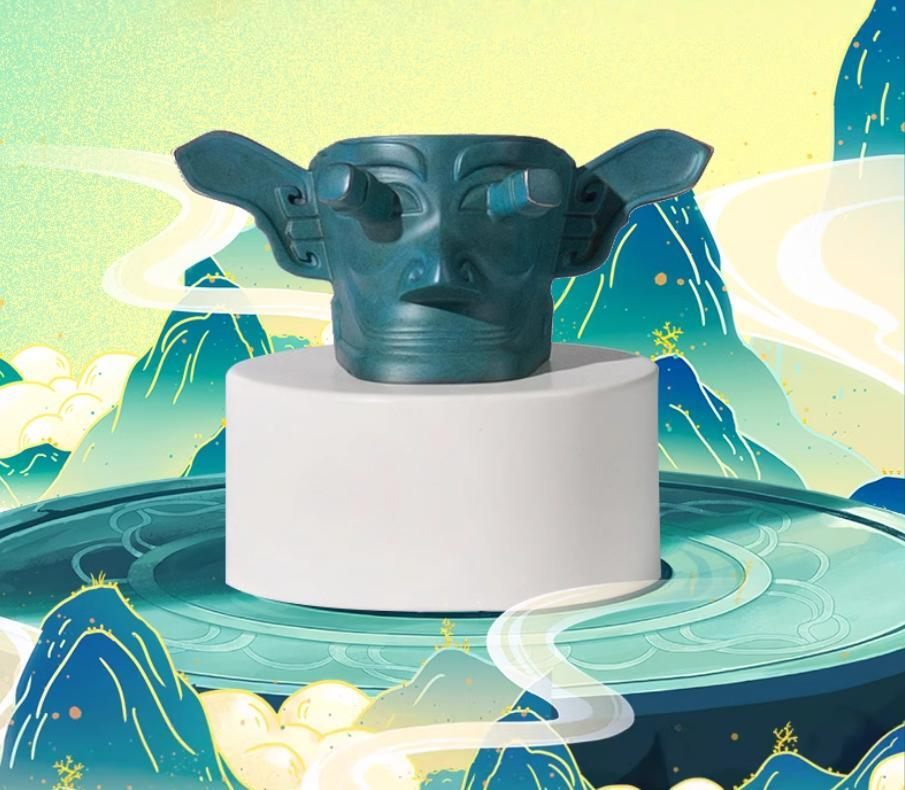
Massive bronze trees standing nearly four meters tall. Human figures with protruding eyes. Gold masks. These objects displayed Chinese bronze casting technique sophistication that rivaled – and in some cases exceeded – contemporary Shang dynasty work.
Some researchers have speculated: Could the Sanxingdui civilization have had contact with the Xia? Could their ritual vessel symbolic design traditions share a common ancestor with the legendary nine tripods?
There's no direct evidence. But for those interested in cognitive dissonance Chinese art and the Western gaze Eastern artifacts, Sanxingdui represents the kind of mystery that makes Chinese ritual bronze art endlessly compelling.
---
The Artistic Legacy: What the Tripods Represented
Even if the physical Da Yu Ding is lost forever, its artistic and cultural influence permeates Chinese decorative arts to this day.
The Ding Form
The basic tripod shape – round body, three legs, two handles – became the archetypal ritual bronze vessels form. Later dynasties continued to cast ding vessels, explicitly referencing the nine tripods' authority.
When you examine Shang Zhou bronze aesthetics in museum collections worldwide – the Metropolitan Museum, the British Museum, the Shanghai Museum – you're seeing the artistic descendants of Yu's original vision.
The Taotie Motif
Those mysterious animal faces that dominate ancient Chinese metalwork art? The taotie motif meaning has been debated for over a century. Some scholars see shamanic symbolism. Others interpret them as protective spirits. Still others argue they represent the "hundred things" mentioned in the *Zuo Zhuan* – the catalog of creatures originally depicted on the nine tripods.
From a Western perspective Chinese art, the taotie represents something profoundly alien: a decorative system that doesn't prioritize beauty in the Greco-Roman sense, but rather power, mystery, and cosmic order.
Chinese aesthetic principles bronze vessels embodied
The nine tripods weren't meant to be "beautiful" in the Western sense. They were meant to be *authoritative*. Their ritual object artistic value derived from their function as mediators between heaven and earth, rulers and ruled, human and divine.
This Chinese aesthetic principles bronze philosophy challenges Western art historical frameworks that separate art from power. In ancient China, they were inseparable.
---
Modern Resonance: Why the Nine Tripods Still Matter
For collectors of Ancient Chinese bronzes and scholars of Chinese water management history, the nine tripods represent more than archaeological curiosity. They embody fundamental questions about legitimacy, power, and cultural memory.
The Political Symbolism
Throughout Chinese history, controlling the narrative about the nine tripods meant controlling the narrative about legitimate rule. When Mao Zedong declared the founding of the People's Republic in 1949, he was consciously positioning himself within a lineage that stretched back to Yu the Great himself.
The imperial authority ancient symbols encoded in the tripod tradition never truly disappeared. They evolved.
The Cultural Memory
In contemporary China, the nine tripods remain potent symbols. Reproductions stand in government buildings. The phrase "stability of the tripods" (*ding sheng*) means national stability. The mythical emperor Yu artifacts continue to shape how Chinese people understand their civilization's origins.
The Academic Debate
Western academia remains divided. The 2022 Cambridge symposium on Bronze Age China featured heated exchanges between "maximalist" scholars (who accept traditional accounts with modifications) and "minimalist" scholars (who demand archaeological proof before accepting any claims).
For intellectually curious individuals following this debate, it represents a fascinating case study in how civilizations construct their own histories.
---
The Ultimate Mystery: Where Are They Now?
Let's address the question everyone asks: Could the Da Yu Ding still exist, waiting to be discovered?
Possibility One: Destroyed
The most likely scenario. Bronze is valuable. Throughout Chinese history, ancient bronzes were routinely melted down for coinage, weapons, or new ritual objects. The nine tripods, if they existed, would have been irresistible targets.
Possibility Two: Hidden
Chinese history is full of deliberately hidden treasures. The tomb of Qin Shi Huang (still unexcavated) reportedly contains rivers of mercury and palaces filled with wonders. Could the tripods be similarly concealed?
Some researchers have even speculated about underwater locations – the Sishui River, certain lakes in Shandong Province – based on ancient textual clues.
Possibility Three: Misidentified
Here's the most intriguing possibility for archaeologists and art historians: What if we've already found fragments of the nine tripods but don't recognize them?
Ancient bronzes were sometimes recast, their material reused but their essence preserved in new forms. A ritual bronze vessels piece in a museum collection might contain metal from the original sacred ding Chinese mythology – a physical connection to Yu the Great bronze legacy, even if the form is lost.
---
Conclusion: The Tripods That Never Died
The Da Yu Ding may be physically absent from the archaeological record, but its presence permeates Chinese ritual bronze art and Chinese imperial symbols to this day.
For collectors, scholars, and culturally curious individuals drawn to ancient Chinese bronzes, the nine tripods represent something unique: a artifact that exists simultaneously in history, mythology, and political philosophy.
They are the ultimate Chinese art historical context puzzle – simultaneously real and imaginary, present and absent, historical and legendary.
In an age of digital reproduction and mass manufacturing, there's something profoundly moving about a sacred ding Chinese mythology that achieved immortality precisely by disappearing. The nine provinces bronze ding became more powerful in absence than they could ever have been in presence.
Perhaps that was Yu the Great's true genius. Not controlling the floods. Not founding a dynasty. But creating a symbol so potent that four thousand years later, we're still talking about it.
Still searching.
Still wondering.
Still casting our own ritual bronzes Xia dynasty would have recognized – not in metal, but in words, in scholarship, in the endless human quest to understand where we came from.
The Da Yu Ding is lost.
But its story?
That's just beginning.