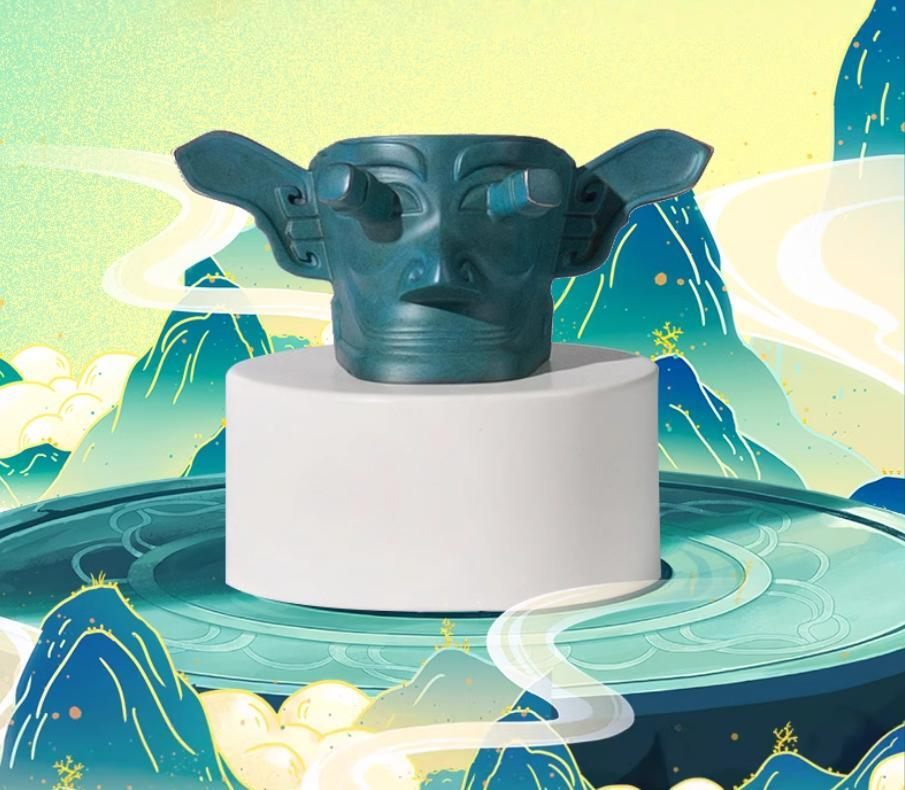

In 1849, somewhere in the dusty fields of Shaanxi Province, a Chinese farmer felt his plow strike something unyielding. What emerged from the earth would become one of the most extraordinary ancient Chinese bronze vessel discoveries in history—a 153.5 kilograms weight of Western Zhou Dynasty power, standing 101.9 centimeters height, its surface covered in mysterious taotie masks that seemed to stare across three millennia.
This is the story of the Da Yu Ding, one of the "Three Treasures of China" alongside the Da Ke Ding and Mao Gong Ding—a bronze ritual vessel so profound that its 291 characters of bronze inscription would preserve a king's warning to his nobleman, survive dynastic collapses, evade grave robbers, and ultimately become a cornerstone of the Chinese National Museum bronze collection.
The “Da Yu Ding” discussed in this article is not the "Da Yu Ding" associated with Yu the Great, who cast the Nine Tripods during his legendary efforts to control the Great Flood! Although both may be transliterated as "Da Yu Ding," they are entirely unrelated; indeed, the vessel in question dates to approximately 1000 years after the Nine Tripods cast by Yu the Great.
But what is the Da Yu Ding really? And why does this Western Zhou bronze ritual vessel matter to anyone living today, especially those of us in the West trying to understand ancient Chinese imperial power symbols?
The King's Decree: A Warning Carved in Bronze
To understand the Da Yu Ding, you must first understand the moment of its creation. Around 1000 BCE, give or take a few decades, King Kang of Zhou sat on his throne in the Western Zhou capital. The Zhou Dynasty was still young—his grandfather, King Wu, had overthrown the corrupt Shang Dynasty just decades earlier, claiming the ancient Chinese mandate of heaven had shifted to his family.
But King Kang worried. The Shang had fallen partly because of decadence, drunkenness, and moral decay. He needed his nobles to remain vigilant, loyal, and disciplined. So he summoned a nobleman named Meng noble family—a trusted advisor whose family name was Yu (hence "Da Yu Ding," or "Great Yu's Ding").
What happened next was recorded not on fragile bamboo strips or perishable silk, but cast permanently into the bronze inscription historical records inside this massive vessel. The King Kang edict to Meng begins with a stark warning:
"The Shang Dynasty fell because they lost the Mandate of Heaven through their excess and drunkenness. Do not follow their path."
This wasn't just friendly advice. This was a Zhou Dynasty royal decree inscriptions—a formal ancient Chinese land grant system document that also served as a moral instruction. In exchange for Meng's loyalty and sobriety, King Kang granted him land, slaves, and ceremonial robes. The bronze vessel inscription translation details these gifts with bureaucratic precision: specific numbers of people, plots of territory, and symbols of status.
Think of it as the ancient Chinese feudal system origins equivalent of a modern employment contract crossed with a performance review—except this one was cast in bronze and weighed over 300 pounds.
The Mystery of Discovery: How the Ding Survived
Here's where the story gets truly remarkable. How was Da Yu Ding discovered? The short answer: by accident. The long answer involves centuries of hiding, protection, and near-misses that read like an Indiana Jones screenplay.
After the Western Zhou Dynasty fell, the Da Yu Ding somehow survived. While other Chinese bronze age timeline artifacts were melted down for their metal value or looted from tombs, this particular bronze ding ritual significance vessel remained intact. Scholars believe it may have been buried intentionally for protection during one of China's many dynastic transitions, or perhaps it remained in continuous use by Meng's descendants for generations.
Fast forward to 1849 discovery year. China was in turmoil—the Qing Dynasty was weakening, foreign powers were circling, and peasant rebellions were erupting across the countryside. When that farmer's plow struck the Da Yu Ding, he had no idea what he'd found. But local scholars did.
News spread. The ancient Chinese noble family history of the Pan family—specifically the renowned collector Pan Zu Yin collector—took interest. Pan recognized this as one of those rare Chinese bronze vessel excavation stories that could define a career. He acquired the ding and brought it to his family collection, where it would remain for over a century.
But here's the thing about owning something this valuable in 19th and early 20th century China: it made you a target. Warlords wanted it. Foreign collectors wanted it. The Japanese military wanted it during their invasion. The Pan family protected the Da Yu Ding through the Second Sino-Japanese War, the Chinese Civil War, and countless other upheavals.
Finally, in 1951 donation year, the Pan family made a decision that would secure the ding's future: they donated it to the newly established People's Republic of China. Today, it sits in the National Museum of China in Beijing, one of the crown jewels of the Chinese National Museum bronze collection.
The Three Treasures: Why This Ding Matters
You might be wondering: there are thousands of ancient Chinese bronze vessel artifacts out there. What makes the Da Yu Ding special enough to be called one of the "three treasures of Chinese bronzes"?
The answer lies in three dimensions: historical, artistic, and textual.
Historically, the Da Yu Ding provides a direct window into Western Zhou political system explained through primary sources. Unlike later historical texts that were written centuries after the events they describe, the bronze inscription on the Da Yu Ding was created contemporaneously with the events it records. This is like having a signed document from King Arthur's court, rather than a medieval romance written 500 years later.
The bronze inscription historical records tell us about ancient China slave system history, land distribution, noble titles, and the Western Zhou clan system explained. They reveal how the Zhou Dynasty justified its rule through the Mandate of Heaven concept, and how that philosophical framework was communicated to the nobility.
Artistically, the Da Yu Ding represents the pinnacle of bronze casting ancient China techniques. The taotie pattern design—those mysterious animal-mask motifs that cover the vessel's surface—aren't just decorative. They're religious symbols, power markers, and artistic statements all at once. Western art historians sometimes compare them to Greek geometric patterns or Egyptian hieroglyphic borders, but the taotie is uniquely Chinese, a visual language that developed independently from other ancient civilizations.
The bronze casting itself is a marvel. Creating a 153.5 kilograms weight vessel with such precise 101.9 centimeters height proportions, uniform wall thickness, and clear 291 characters of text required extraordinary technical sophistication. The piece mold technique used by Zhou artisans was so advanced that modern metallurgists still study these vessels to understand how Chinese bronzes differ from Egyptian or Mesopotamian metalwork.
Textually, the Da Yu Ding inscription is one of the longest and most important Chinese bronze inscriptions ever discovered. For scholars of Rong Geng Jin Wen Bian (the comprehensive catalog of bronze inscriptions), this text is foundational. Scholars like Tang Lan scholar, Ma Chengyuan expert, and Li Xueqin historian have built careers analyzing these 291 characters meaning.
The Alcohol Warning: A Surprisingly Modern Message
Here's a detail that always fascinates Western audiences: much of King Kang's warning to Meng focuses on ancient Chinese warning against alcohol.
The inscription explicitly tells Meng not to become drunk like the Shang nobles did. This isn't just moralizing—it's practical political advice. The Shang Dynasty's collapse was attributed partly to a culture of excessive drinking among the elite, which led to poor governance, corruption, and ultimately rebellion.
From a Western Zhou vs Mesopotamian art perspective, this is fascinating. While Mesopotamian kings were carving their victories in battle on stone steles, and Egyptian pharaohs were depicting their divine status on temple walls, the Zhou King was casting a warning about sobriety and good governance into bronze.
This reflects a fundamentally different approach to power. The Chinese mandate of heaven concept wasn't just about divine right—it was conditional. You ruled well, Heaven supported you. You ruled poorly (got drunk, ignored your duties, oppressed your people), Heaven withdrew its mandate, and you were overthrown.
For American readers familiar with the Declaration of Independence's "consent of the governed," there's an interesting parallel here. The Mandate of Heaven is, in some ways, an ancient Chinese version of political accountability—except the "voters" were supernatural forces rather than citizens.
Cross-Cultural Connections: East Meets West
So why Chinese used bronze for rituals instead of other materials? And how Chinese bronzes differ from Egyptian or Greek ritual objects?
The answer reveals fundamental differences in how these civilizations understood the relationship between humans, gods, and power.
In ancient Greece, ritual vessels were often made of pottery or precious metals—gold, silver, electrum. The focus was on beauty and material value. In Egypt, ritual objects were frequently made of stone or gold, designed to last for eternity in tombs.
But in China, bronze was special. It wasn't just a material—it was a technology of power. The ability to cast large bronze ritual vessel objects required centralized control over resources (copper, tin, lead), specialized labor (miners, smelters, mold-makers, casters), and sophisticated organization. Only a state with significant power could produce something like the Da Yu Ding.
Furthermore, Chinese bronzes were designed for active use in rituals, not just passive display. The bronze ding ritual significance meant these vessels held food and wine offerings to ancestors. They were functional sacred objects, not just art pieces.
When you look at Chinese bronze vs Greek sculpture, you're seeing two different approaches to permanence and meaning. Greek sculpture sought to capture ideal human forms in marble or bronze. Chinese bronze vessels sought to create functional objects that connected the living with the dead, the present with the past, humans with heaven.
The Modern Journey: From Private Collection to National Treasure
The Chinese archaeology 19th century discoveries era was a chaotic time for artifacts like the Da Yu Ding. Western powers were extracting Chinese antiquities at an alarming rate, often through questionable means. Many of China's greatest treasures ended up in museums in London, Paris, and New York.
The Da Yu Ding narrowly avoided this fate. The Pan family's protection, followed by their Chinese artifact donation to state in 1951, ensured it remained in China. This decision reflected a broader post-1949 understanding that China's cultural heritage belonged to the Chinese people, not private collectors or foreign museums.
Today, when you visit the National Museum of China in Beijing, the Da Yu Ding occupies a place of honor. It's not just an artifact—it's a symbol of cultural continuity, technical achievement, and philosophical depth.
For ancient China land grant system scholars, it's a primary source document. For bronze vessel weight and dimensions enthusiasts, it's a masterpiece of engineering. For Western Zhou capital location history researchers, it's evidence of early Chinese state formation. And for general visitors, it's simply awe-inspiring—a 153.5 kilograms weight object that has survived 3,000 years to tell its story.
Unanswered Questions: What We Still Don't Know
Despite over a century of study, the Da Yu Ding still holds mysteries. How old is Da Yu Ding exactly? Scholars debate whether it dates to King Kang's reign (traditional view) or slightly later, to King Zhao's period. The bronze inscription 291 characters meaning contains passages that remain contested—some bronze vessel inscription translation disagreements persist among experts.
The Chinese bronze age timeline placement is relatively secure (Western Zhou, roughly 1046-771 BCE), but the precise decade remains uncertain. Some Western Zhou political system explained scholars use stylistic analysis of the taotie pattern design to argue for specific dates, while others rely on the bronze inscription historical records content itself.
There's also the question of whether other ancient Chinese bronze vessel objects were buried with the Da Yu Ding. Chinese bronze vessel excavation stories often reveal multiple artifacts in single caches. Did the Meng noble family bury other ritual vessels alongside this ding? If so, where are they?
And perhaps most intriguingly: what happened to the Da Yu Ding between the Western Zhou Dynasty's collapse and its 1849 rediscovery? Chinese bronze vessel excavation stories from this gap period are sparse. Did it remain above ground, passed down through generations? Or was it buried intentionally, and if so, why and by whom?
Why the Da Yu Ding Matters Today
In an age of digital ephemera, where content disappears as quickly as it's created, the Da Yu Ding offers a different model of permanence. King Kang's warning to Meng has outlasted empires, languages, and technologies. The bronze inscription remains legible after 3,000 years—a testament to the power of casting ideas into durable form.
For Western audiences trying to understand ancient Chinese imperial power symbols, the Da Yu Ding provides a concrete entry point. This isn't abstract philosophy or lost literature—it's a physical object you can visit, photograph, and study. The Chinese National Museum bronze collection makes it accessible to anyone willing to travel to Beijing.
For scholars of ancient Chinese feudal system origins, the Da Yu Ding inscription is invaluable primary source material. It reveals how early Chinese states functioned, how power was distributed, and how legitimacy was maintained.
And for anyone fascinated by Chinese archaeology 19th century discoveries stories, the Da Yu Ding offers a narrative of survival, protection, and ultimate preservation that rivals any museum thriller.
Planning Your Visit: Seeing the Da Yu Ding
If you're planning to see the Da Yu Ding in person, here's what you need to know:
Location: National Museum of China, Beijing (East Chang'an Avenue, Dongcheng District)
Collection: Ancient China Hall, Bronze Age section
Viewing: The Da Yu Ding is typically on permanent display, though special exhibitions may temporarily relocate it
Photography: Generally permitted without flash
Best time to visit: Weekday mornings tend to be less crowded
The National Museum of China is one of the world's great museums, and the Da Yu Ding is one of its crown jewels. Standing before this 153.5 kilograms weight Western Zhou bronze ritual vessel, you're looking at an object that has witnessed three millennia of human history—and somehow survived to tell its story.
The Legacy Continues
The Da Yu Ding began as a king's warning to his nobleman. It became a family treasure, a national icon, and now a window into ancient Chinese civilization for the modern world.
When King Kang cast his decree into bronze, he couldn't have imagined that 3,000 years later, people from around the world would still be reading his words, studying his vessel, and marveling at his civilization's achievements.
That's the power of the Da Yu Ding. That's why it's one of the "Three Treasures of China." And that's why this ancient Chinese bronze vessel continues to speak across time, carrying its message of loyalty, sobriety, and good governance to anyone willing to listen.